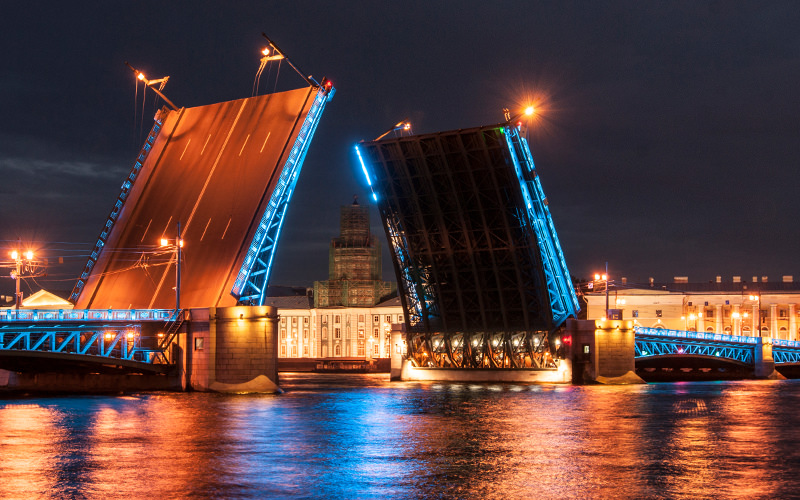
The Palace Bridge has long been more than just a crossing; it is the true soul and calling card of Saint Petersburg. Every day, thousands of residents and tourists stroll here. And on warm summer evenings, the surrounding embankments transform into a cozy open-air auditorium, offering a perfect vantage point to watch the famous bridge drawing.


History of the Bridge
The first crossing appeared in this area back in the first half of the XVIII century, connecting the modern Senate and Synod buildings with the Menshikov Palace. This bridge was called St. Isaac's and was temporary: it was dismantled for the winter, and people crossed the Neva on ice. I read, by the way, that in the past there was a ceremony where one of the court jesters would cross the frozen river with a drum, notifying the locals of the start of winter navigation. It’s worth noting that the ritual was quite safe for the jester: he was accompanied by several people with rescue equipment.


After the Annunciation Bridge was built in Saint Petersburg, the citizens requested to move the St. Isaac's Bridge closer to the Winter Palace. The relocation work was completed by 1856, around the time the bridge became known as the Palace Bridge. Towards the end of the XIX century, the crossing was moved to its modern-day location.
In 1901, a competition was announced for the construction of a permanent Palace Bridge, but no winner was declared. Subsequently, the city authorities held two more stages of the competition, featuring 54 design projects. Eventually, the plan by engineer Andrey Pshenitsky and architect Robert-Friedrich Meltzer was approved.


Construction was completed by 1916. It was supposed to be finished earlier, but a flood and the First World War hindered the plans. The official opening date of the bridge is December 23, 1916. Interestingly, despite the bridge's apparent significance to the city, only ten percent of the invited guests attended the opening ceremony, and no members of the royal family were present. This was due to both the aforementioned war and the recent murder of Grigori Rasputin. The final decoration of the bridge was only finished in the Soviet era—until 1939, the bridge's railing remained wooden.
From 1918, the bridge was renamed the Republican Bridge. There were plans to return its historical name in 1952, though in practice it didn't happen—the decision was overturned a year later. However, in the following year, 1954, the bridge finally regained the name "Palace Bridge."


How to Get There by Metro
I believe the location of the Palace Bridge is known to almost every tourist visiting the city. If you are coming to Saint Petersburg for the first time, you can take the metro to "Admiralteyskaya," walk onto Palace Square through the arch of the General Staff Building, take a look at the Winter Palace, and head across the Palace Bridge, for instance, toward the Peter and Paul Fortress.
I’ve read that the Palace Bridge is drawn about 400 times a year. Last year, the bridge was opened at 1:10 AM, closed at 2:50 AM, and opened again at 3:10 AM. It’s also mentioned online that occasionally one of the bridge's leaves serves as a giant screen, though I haven't witnessed this myself.
Enjoy your walks!